
Lt Cdr Ash Loftus (FAAOA Ambassador)
I walk through the hangar, past engineers working on aircraft, and out onto the flight line. Inside, the hangar is busy. Panels are open, toolboxes sit alongside aircraft in various stages of maintenance and conversations drift between engineers as they work through another day’s tasks. It has a familiar rhythm. Outside, by comparison, there is an unexpected calm. Waiting on the line is the aircraft I am about to fly, the venerable MQ-9A Reaper, already prepared for its next flight.
The crew chief is standing beneath the aircraft’s enormous tail, waiting for me to arrive. We talk through the plan for the sortie; how we are going to start the aircraft, anything out of the ordinary that I should know, and the sequence of events that will get us from a parked aircraft to one ready to taxi. It is a routine conversation, and one that would be familiar to anyone who has prepared an aircraft for flight.
I begin my walkaround.
The MQ-9 is an unusual aircraft to inspect. The slender nose probe looks almost impossibly delicate, while the large sensor turret beneath the fuselage gives the aircraft its unmistakable appearance. At the front, a pair of small cameras stare back at me, soon to become my cockpit canopy. I walk beneath the wing, high enough that I almost don’t need to bend over, checking the control surfaces, pitot tubes, landing gear and brakes before making my way around the massive tail and back towards the nose. Like any walkaround, I am not looking for one specific fault. I am simply building a picture of the aircraft I am about to fly.
I do not always have the opportunity to do this. Many MQ-9 sorties are flown with the aircraft operating thousands of miles away, in which case the walkaround belongs to the crew chief and maintenance team wherever the aircraft happens to be. Here, however, the aircraft is parked barely a hundred feet from the ground control station. I can walk out to it myself and, perhaps because I grew up around more conventional aviation, it simply feels like the right thing to do.
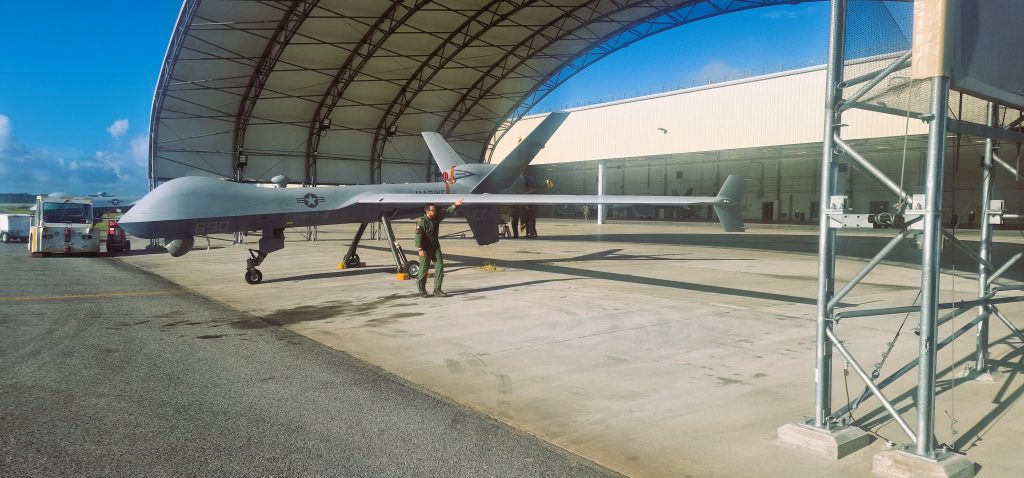
Before heading inside, I stop for a moment and look up.
The weather brief is already complete. I have read the METAR and TAF, listened to ATIS and spent time looking at forecast radar imagery, winds and vertical profiles. The information tells me what the atmosphere is expected to do. Standing beside the aircraft tells me what it is doing now.
The North Carolina spring is already warm. There is just enough wind to make itself noticed and, over towards the coast, the first cumulus clouds of the afternoon are beginning to build. A pair of F-35s depart from a neighbouring runway and I find myself watching them climb until they disappear into the cloud layer, instinctively judging the height of the bases rather than simply accepting the numbers I have read.
It is a habit that probably never leaves a prior air traffic controller, and I assume it’s the same for a pilot.
The walk to the ground control station takes less than a minute, but it feels like stepping into a different world. The warmth of the flight line gives way to cool air conditioning. Bright sunshine becomes subdued lighting as my eyes adjust. The quiet hum of electronics replaces the sounds of the airfield. The aircraft is still only around a hundred feet away, but my cockpit is now here.
I complete the initial checklists and establish the connection.
The video feed appears, and with it the same crew chief I had been talking to only a few minutes earlier. I am now looking at him through the aircraft’s cameras rather than across the flight line. Once everything is ready, he disconnects the external data cable, marshals me forward and, before I begin to taxi, offers a crisp salute.
It feels wrong not to return it.
The longer I spend here, the more I find myself reflecting on the perceptions surrounding unmanned aviation. It is easy to assume that the biggest misconception is a technical one; that people imagine the aircraft flies itself or that the human element has been totally removed. In my experience, that is rarely the case. Most people understand there are pilots, sensor operators, engineers and a considerable team involved in every sortie.
The misconception is, I think, rather more subtle than that.
It is the perception that the people involved are somehow detached from the aircraft because they sit behind screens. That they are separated from the machine they operate, from the environment in which it flies and, perhaps, from the consequences of the decisions they make. Having spent years in unmanned aviation, and now in an MQ-9 squadron, that simply has not reflected my experience.
The technology has undoubtedly changed where the pilot sits, but it has not changed the pilot’s relationship with the aircraft, nor their responsibility for operating it safely and effectively.
The same is true of the people around it.
Spend time in an MQ-9 squadron and a different picture emerges. The aircraft is surrounded by engineers and maintainers who understand it in extraordinary detail. Pilots and sensor operators operate it with professionalism and pride. Intelligence specialists, mission planners, operations staff and many others contribute to every mission. Each brings a different expertise, but nobody feels like they are on the periphery of aviation. They are simply doing aviation in a different way.
That became particularly clear during my first squadron formation. Having spent much of my career around ships, air traffic control towers and manned aviation, I expected an MQ-9 squadron to feel different. Instead, it felt immediately familiar. The personalities were familiar. The humour was familiar. The pride people took in their work, the inevitable frustrations when things did not go to plan and the willingness to learn from one another all felt exactly as I had experienced throughout my career in conventional aviation.
It reminded me that squadrons are defined far less by the aircraft they operate than by the people who serve in them.
If there is one thing I would hope someone considering a posting to an unmanned squadron might take away from this, it is that you are not joining a room full of people detached from aircraft, watching aviation unfold at a distance. You are joining a squadron of aviators. The aircraft may be remotely operated and the cockpit may no longer be inside the fuselage, but the qualities that matter have not changed. Professionalism, judgement, teamwork and an enduring curiosity about aircraft and flying remain just as important as they have always been.
The aircraft is different.
The people are not.